Disclosure: This post contains affiliate links. If you make a purchase through these links, I may earn a small commission at no additional cost to you.
Somewhere around six months, your sleepy little newborn turns into a busy explorer. One week they’re wobbling in a sitting position, and the next they’re scooting across the floor toward the dog’s water bowl.
The second half of the first year is packed with huge leaps. Most babies learn to sit on their own, pick up tiny things with their fingertips, creep, crawl, pull to stand, and maybe even cruise along the furniture.
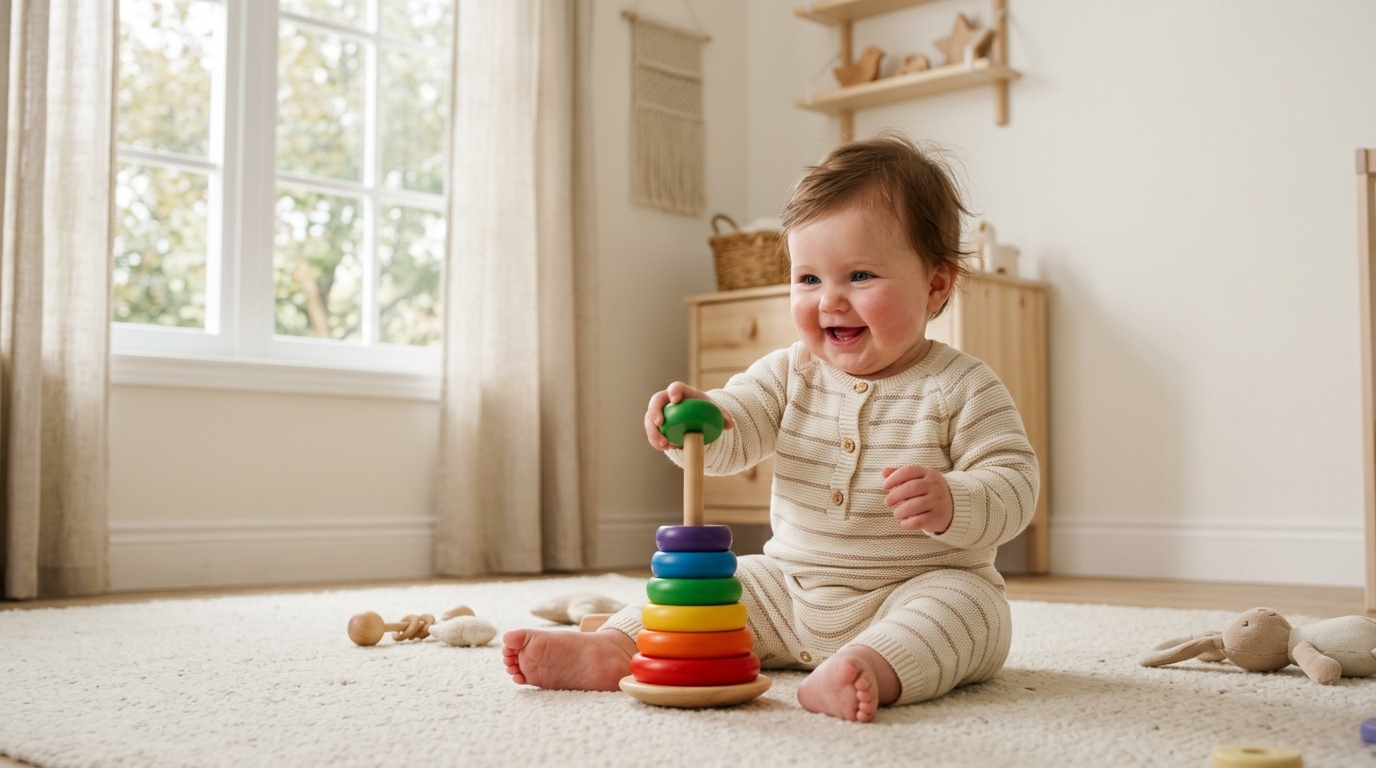
That’s a lot of growing in six months! The good news? These 6-12 month baby activities don’t need fancy toys or a lot of prep.
Simple play like dumping blocks, crawling over pillows, and pulling scarves from a box builds strength, coordination, and early cause-and-effect thinking. A few minutes of focused play each day is plenty. Pick what fits your baby’s stage, and have fun with it.
Independent Sitting & Balance Play (6–8 Months)
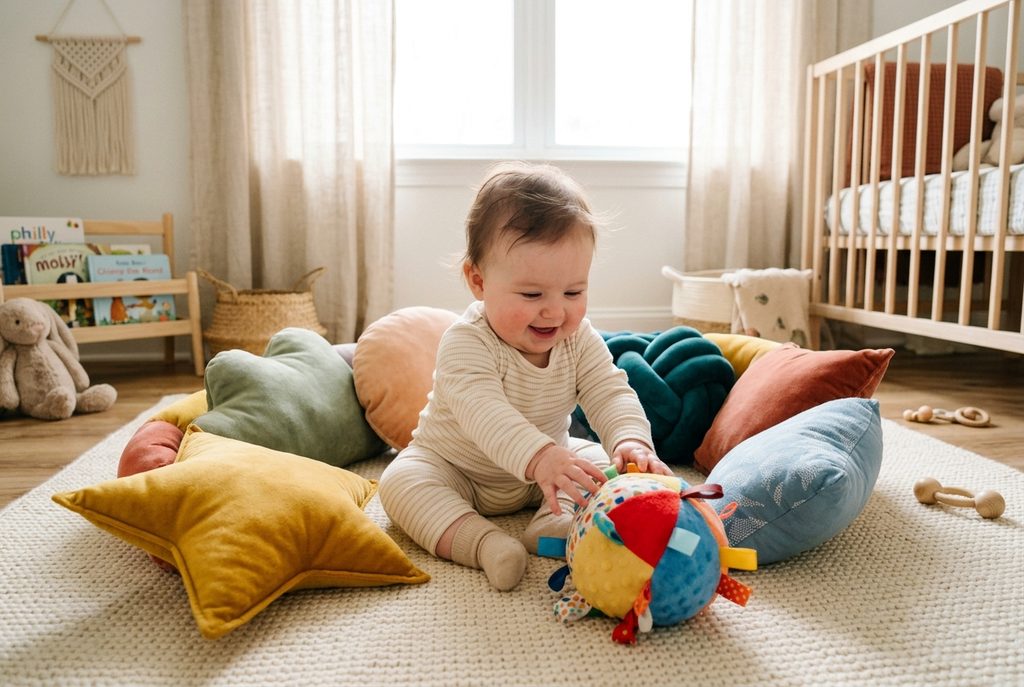
Sitting takes a surprising amount of core strength and balance. At first, babies lean forward on their hands like a little tripod, then slowly learn to sit tall and catch themselves when they tip.
Tipping over is part of learning, so make every fall a soft one. Play on a carpet or play mat with pillows nearby, and stay within arm’s reach. These sitting baby activities make baby balance play feel like a game.
For quick sitting practice during meal prep, stick a set of suction cup spinner toys onto highchair trays to build fine motor rotation skills.
1. Pillow-Fort Ring Sit
A ring of pillows gives wobbly sitters a safe place to practice.
- Sit your baby on a play mat or carpet.
- Place a nursing pillow or ring of firm pillows around them.
- Put one or two toys just in front of them to reach for.
- Stay close and gently help them back up when they tip.
Pro-Tip: Place toys slightly to each side, not just straight ahead. Reaching sideways builds the balance reactions that stop future face-plants.
2. Tissue-Box Pulling
Pulling scarves out of a box is one of the most popular 7 month old play ideas, and it costs nothing.
- Gather four or five soft fabric squares, like muslin cloths or baby washcloths.
- Stuff them loosely into an empty tissue box.
- Pull the first one halfway out and show your baby.
- Let them pull the rest out, then stuff them back in together.
Pro-Tip: Use short fabric squares only, and put them away after play. Long scarves aren’t safe for babies to play with unsupervised.
3. Laundry Basket Ball Drop
This one builds balance while your baby reaches up and lets go.
- Sit your baby next to an empty laundry basket.
- Hand them a soft ball bigger than their fist.
- Show them how to drop it into the basket.
- Cheer loudly every time it lands, then hand it back.
Pro-Tip: Sit your baby inside a low basket with a few soft toys for extra support. Stay right beside them, since baskets can tip.
4. Mirror Peek-a-Boo
Babies at this age are fascinated by faces, especially their own.
- Prop an unbreakable mirror in front of your sitting baby.
- Cover the mirror with a light cloth.
- Ask, “Where’s the baby?” and pull the cloth away.
- Let them try pulling the cloth off themselves.
Pro-Tip: Peek-a-boo teaches object permanence, the idea that things still exist when they’re hidden. That’s a big brain milestone!
Cause-and-Effect & Fine Motor Explorations (7–9 Months)
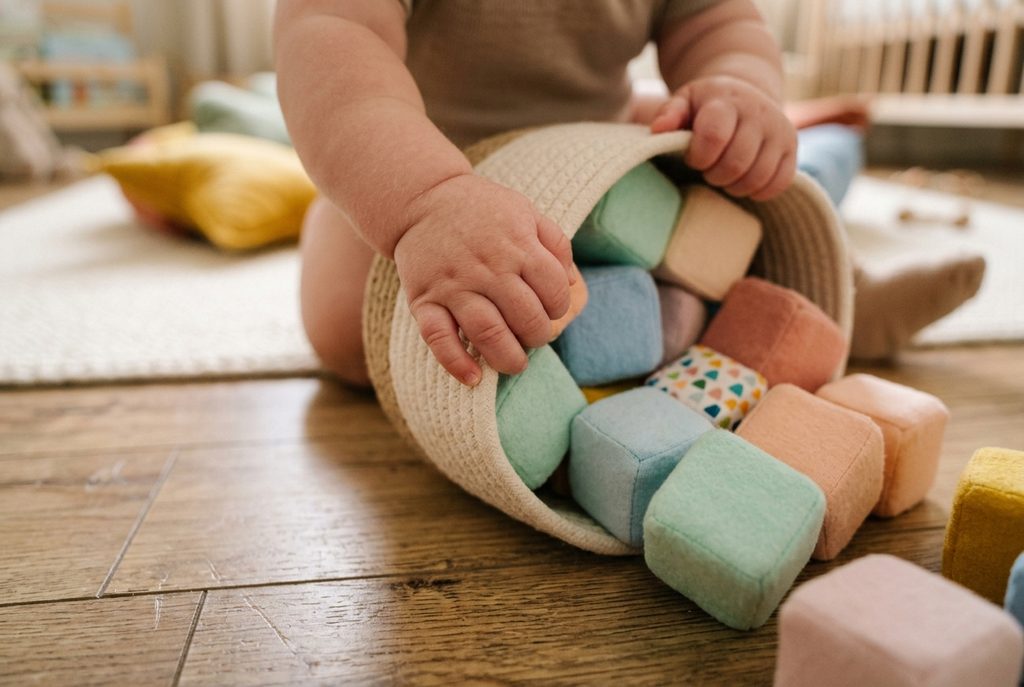
Around 8 months, babies start to figure out that their actions make things happen. Drop the spoon, and mom picks it up. Bang the cup, and it makes a noise.
These 8 month old cause and effect games feed that curiosity. They also strengthen little hands for grabbing, releasing, and poking.
5. Container Dumping & Filling
Container play for babies is simple, cheap, and endlessly fun.
- Grab a plastic container or bowl and a handful of large toys or blocks.
- Fill the container and let your baby dump it out.
- Show them how to put one item back in.
- Repeat as long as they’re interested.
Pro-Tip: Dumping comes before filling. Don’t worry if your baby only empties things for a while. Filling usually clicks a few weeks later.
6. Soft Block Stacking
Babies can’t stack yet, but they love knocking towers down.
To encourage cause-and-effect learning without injury, introduce soft silicone stacking blocks that are safe for teething infants to grasp, stack, and knock over.
- Build a short tower of two or three blocks in front of your baby.
- Let them knock it down.
- Gasp, laugh, or say “Boom!”
- Rebuild and repeat.
Pro-Tip: Once they can grab one block, try placing one on top of another hand-over-hand. Most babies stack two blocks closer to their first birthday.
7. Ribbon Box Pulls
This upgraded pulling game builds finger strength and focus.
- Poke a few holes in a shoebox lid.
- Thread short ribbons through and knot them on the inside.
- Show your baby how to tug each ribbon.
- Pull from the inside to make the ribbons “disappear” again.
Pro-Tip: Keep ribbons under 12 inches and always supervise. Long strings are a strangulation risk.
8. Edible Paint Squishing
Once your baby has started solids, edible paint is messy sensory fun you don’t have to worry about.
- Mix plain, full-fat yogurt with a spoonful of smooth fruit puree for color.
- Strip your baby to their diaper and sit them in the highchair.
- Spoon blobs of “paint” onto the tray.
- Let them squish, smear, and taste.
Pro-Tip: Only use foods your baby has already eaten without a reaction. Skip honey before 12 months.
Mastering the Pincer Grip
The pincer grip is when your baby picks things up between their thumb and index finger. It usually develops between 9 and 12 months and is a key part of 9 month old motor skills.
Before the pincer grip, babies rake things toward them with their whole hand. Practice helps them learn to isolate that pointer finger, which later helps with self-feeding, buttons, and holding crayons.
These baby pincer grip activities use soft foods and should only be done while your baby is seated upright and supervised.
9. Puff Pick-Up
- Place your baby in their highchair.
- Put one dissolvable baby puff in each cup of a muffin tin.
- Encourage them to pick each puff out and eat it.
- Add more as they get faster.
Pro-Tip: The muffin tin stops raking. Your baby has to dip in with their fingertips, which is great pincer practice.
10. Squished Pea Pinch
- Cook peas until very soft.
- Gently squish each pea flat with a fork.
- Scatter a few on the highchair tray.
- Let your baby pinch them up one at a time.
Pro-Tip: Always squish round foods like peas, blueberries, and grapes for babies. Whole round foods are a choking hazard.
Crawling & Movement Incentives (9–11 Months)
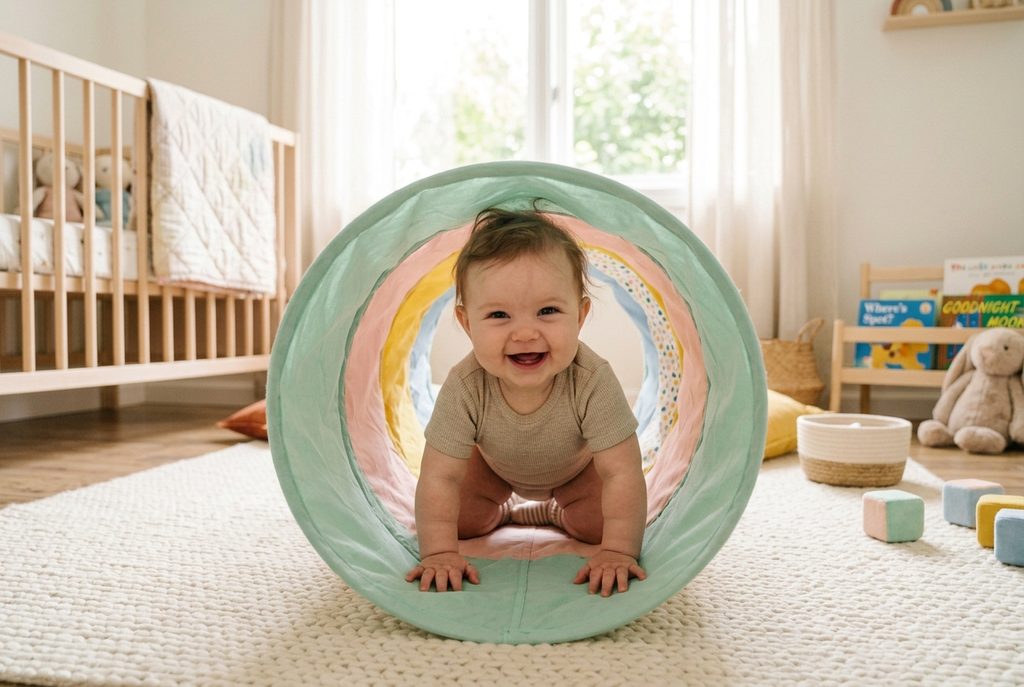
Some babies crawl at 7 months, some at 10, and some skip it and scoot instead. Every baby moves on their own timeline.
These 10-12 month crawling games work for babies who are just starting out and for speedy crawlers who need a challenge.
11. Pillow Mountain Climbing
- Pile a few couch cushions and pillows on the floor.
- Place a favorite toy on the other side.
- Encourage your baby to crawl up and over.
- Spot them closely and help them down safely.
Pro-Tip: Climbing over uneven surfaces builds strength and body awareness far more than flat floors alone.
12. Tunnel Crawling
- Set up a pop-up play tunnel, or open both ends of a large cardboard box.
- Sit at one end and call your baby through.
- Roll a ball through the tunnel for them to follow.
- Celebrate when they pop out the other side!
Pro-Tip: Some babies feel nervous in tunnels at first. Start with a short tunnel, and let them see your face at the other end.
13. Chasing Rolling Balls
- Sit across from your baby on the floor.
- Gently roll a large, soft ball just past them.
- Encourage them to crawl after it.
- Roll it back and forth as a game.
Pro-Tip: Balls with bells inside give babies a sound to follow, which keeps them chasing longer.
14. Sofa-Cruising Tracks
Once your baby pulls up to stand, the couch becomes the perfect practice track.
- Line up a few toys along the edge of the couch.
- Help your baby pull up at one end.
- Encourage them to side-step along to reach each toy.
- Gradually space the toys farther apart.
Pro-Tip: Move the coffee table or pad sharp corners before cruising practice begins.
Standing, Cruising & Problem-Solving (10–12 Months)
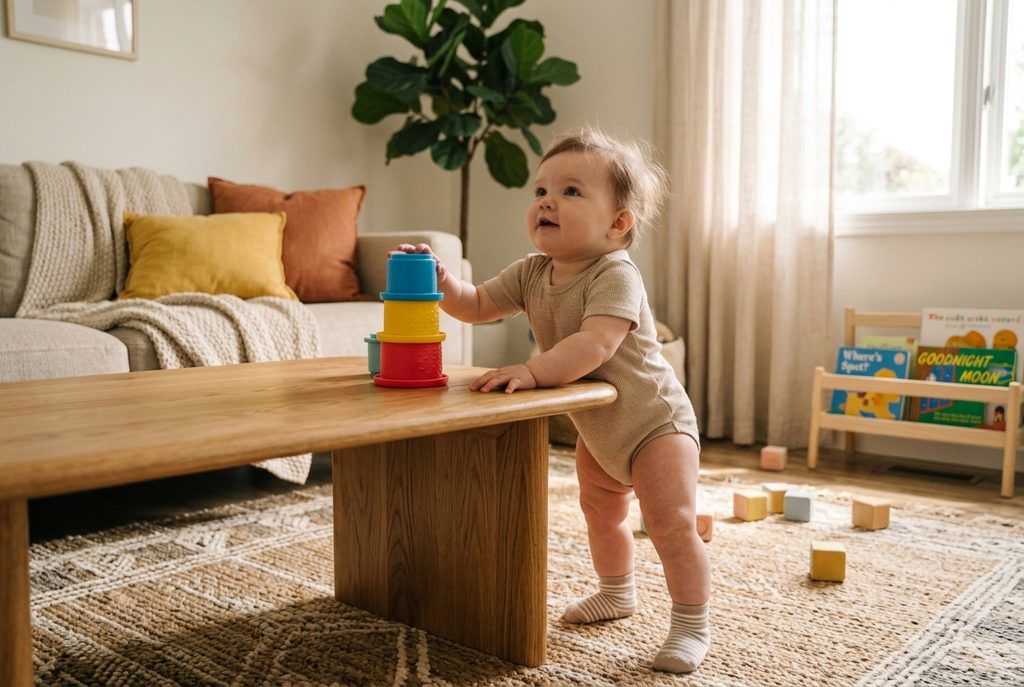
Close to their first birthday, babies want to stand, explore, and figure things out. These activities build leg strength and early problem-solving skills.
15. Sticky Tape Wall Reach
- Stick painter’s tape loops on a wall at your baby’s standing height.
- Press light paper shapes or pictures onto the tape.
- Help your baby stand and pull each one off.
- Put them back up and play again.
Pro-Tip: Watch closely so tape and paper don’t end up in their mouth.
16. Laundry Hamper Obstacle
- Place a sturdy, empty laundry hamper in the middle of the floor.
- Put a toy on the other side.
- Let your baby figure out how to cruise around it or push it aside.
- Change the position to create a new “puzzle.”
Pro-Tip: Let them struggle a little before stepping in. Problem-solving grows when they get to try first.
17. Sensory Shaker Bottles
- Fill clean, small plastic bottles with rice, dry pasta, or colorful water.
- Glue the lids shut and wrap them with strong tape.
- Hand them to your baby to shake, roll, and watch.
- Roll one across the floor to encourage crawling after it.
Pro-Tip: Check the lids before every use. Toss any bottle with a loose lid or cracks.
18. Push-Toy Practice
- Choose a sturdy, weighted push toy that won’t tip.
- Help your baby stand and hold the handle.
- Walk slowly beside them as they push.
- Practice on carpet first, since it slows the wheels down.
Pro-Tip: Push toys are different from seated baby walkers. Experts advise against seated walkers because of fall and injury risks.
Highchair Play While Mom Preps Dinner
Need five minutes to chop veggies? These highchair play ideas keep babies busy and safely strapped in.
19. Sticky Note Peel
- Stick five or six sticky notes on the highchair tray.
- Show your baby how to peel one off.
- Let them peel the rest while you cook.
Pro-Tip: Collect the notes as they peel them so none end up as a snack.
20. Muffin Tin Treasure Hunt
- Place a few safe, chunky toys in a muffin tin.
- Cover each cup with a silicone cupcake liner or a small cloth.
- Let your baby uncover each “treasure.”
Pro-Tip: Rotate the hidden toys each night so the game feels new.
Bonus: Measuring Cup Bang
- Hand your baby a set of plastic measuring cups and a wooden spoon.
- Show them how to bang, stack, and nest the cups.
- Join in with a silly beat from the counter.
Pro-Tip: Keep your baby within sight at all times and never leave them alone in the highchair, even for a quick minute.
Safety Rules for 6-12 Month Baby Activities & Mobile Babies
Once your baby is on the move, your home suddenly looks very different. Get down on your hands and knees and look at each room from their level.
- Baby-proof early. Cover outlets, add gates at the top and bottom of stairs, and tie up blind cords.
- Watch for choking hazards. If something fits through a toilet paper tube, it’s too small. Be extra careful with coins, button batteries, and magnets.
- Secure heavy furniture. Anchor dressers, bookshelves, and TVs to the wall so they can’t tip over.
- Lock away dangers. Keep medicines, cleaning products, and laundry pods up high and locked.
- Never leave water unattended. Empty buckets, tubs, and kiddie pools right after use.
- Supervise constantly. Mobile babies can move incredibly fast, and most accidents happen in seconds.
Pro-Tip: Every baby develops at their own pace, but talk to your pediatrician if your baby isn’t sitting with support by around 9 months, isn’t bearing weight on their legs, or loses skills they once had.
Progress Over Perfection: Enjoying 6-12 Month Baby Activities
You don’t need to do every activity on this list. Pick one or two a day that match your baby’s stage, and follow their lead.
Some days they’ll crawl through the tunnel ten times. Other days they’ll just want snuggles, and that’s perfectly okay. Progress matters more than perfection.
Before you know it, your little explorer will be toddling into their next big adventure. Enjoy these busy, messy, wonderful months, mama. You’re doing great.
About the Author