Disclosure: This post contains affiliate links. As an Amazon Associate I earn from qualifying purchases without any additional cost on you.
Vroom, beep, choo-choo! If your preschooler lights up at every fire truck, train, and airplane, you already have the perfect hook for early STEM learning.
These transportation activities for preschool turn that love of wheels and wings into real science, math, and hands-on skills. Kids race cars down ramps, sort vehicles, and float homemade boats, all with things you probably already own.
For more themes to rotate through the year, explore our complete guide to 50+ fun preschool activities.
A preschool transportation theme packs a lot into simple play. Kids explore early physics, practice sorting and logic, and build fine motor skills every time they push, stamp, or steer.
Why Transportation Play Boosts Early STEM Learning
Physics & Spatial Concepts (Incline, Momentum, Friction)
When a child sends a car down a ramp, they’re running a physics experiment. A steeper ramp (incline) makes the car go faster, and a heavier car can roll farther once it gets going (momentum).
Surfaces matter too. A car slows down quickly on carpet but zooms across a smooth floor, because rough surfaces create more friction.
You don’t need the big words yet. Ask “What do you think will happen?” before each test, then talk about what you saw.
Categorization & Logic Skills (Land, Air, and Water Classification)
Sorting vehicles teaches kids to notice how things are alike and different. Air, land, and water vehicle sorting is a simple way to practice grouping by one rule.
Kids learn to explain their thinking: “A boat goes in water, so it goes here.”
Some vehicles break the rules, like seaplanes that land on water. Those tricky ones spark the best conversations.
10 Hands-On Transportation Activities for Preschool Play
Each activity takes 15 minutes or less to set up. Here’s the quick list.
| Activity | Ages | Main Skill |
|---|---|---|
| Painter’s Tape Highway | 2–5 | Fine motor & spatial play |
| Cardboard Ramp Speed Test | 3–5 | Physics & predicting |
| Land, Air & Water Sorting Mat | 3–5 | Sorting & logic |
| Muddy Car Wash Bin | 2–5 | Sensory play |
| Tire Track Stamp Painting | 2–5 | Art & cause and effect |
| Alphabet Train Tracks | 3–5 | Letter recognition |
| Foil River Boat Race | 3–5 | Engineering & breath control |
| Construction Excavation Bin | 3–5 | Digging & counting |
| Traffic Light Stop-and-Go | 2–5 | Listening & gross motor |
| Shape Vehicle Collage | 3–5 | Shapes & cutting |
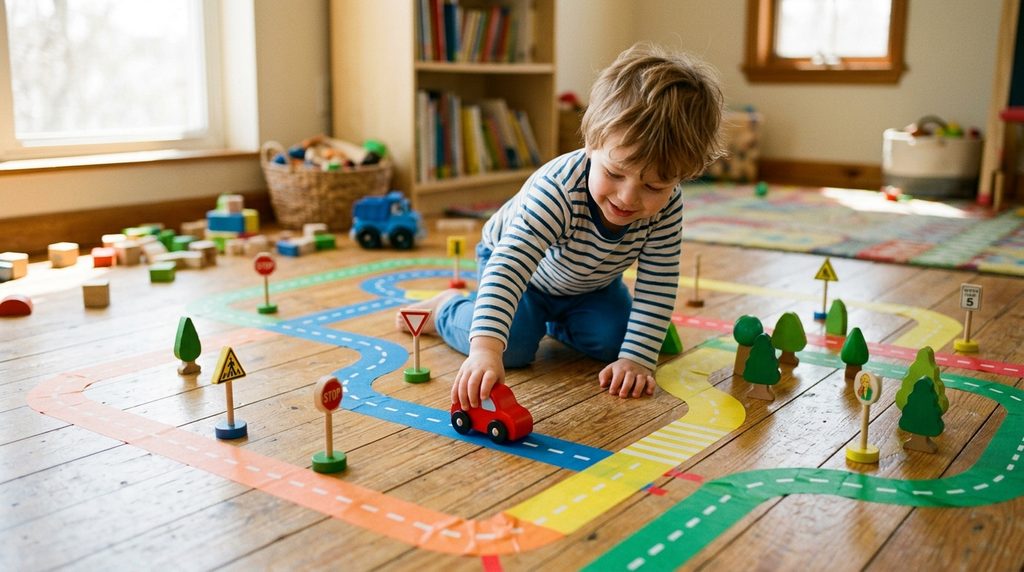
1. Painter’s Tape Highway
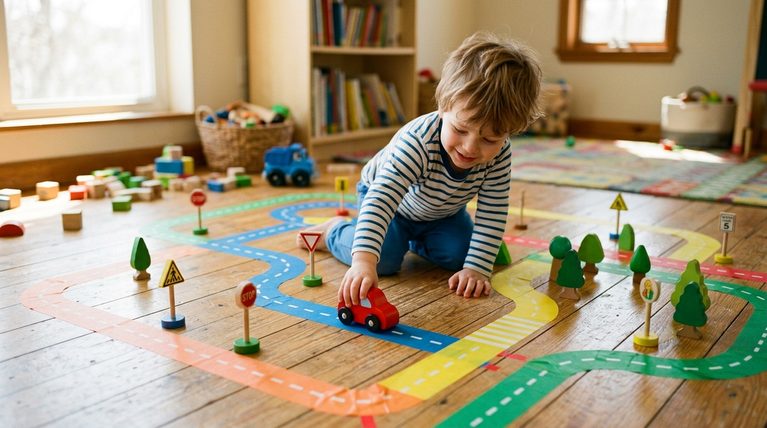
One of the easiest vehicle play ideas for toddlers and preschoolers alike.
Ages: 2–5 · Builds: spatial awareness, fine motor skills, imagination
What You’ll Need: painter’s tape, toy cars, small blocks for buildings
- Tape long roads across the floor with curves, turns, and a roundabout.
- Add a parking lot square and a few block “buildings.”
- Let kids drive cars along the lines without leaving the road.
- Give directions to follow, like “Drive to the red house, then park.”
Variation: Let older kids design and tape their own road map.
Pro-Tip: Painter’s tape peels cleanly off most floors. Test a small spot first on delicate surfaces.
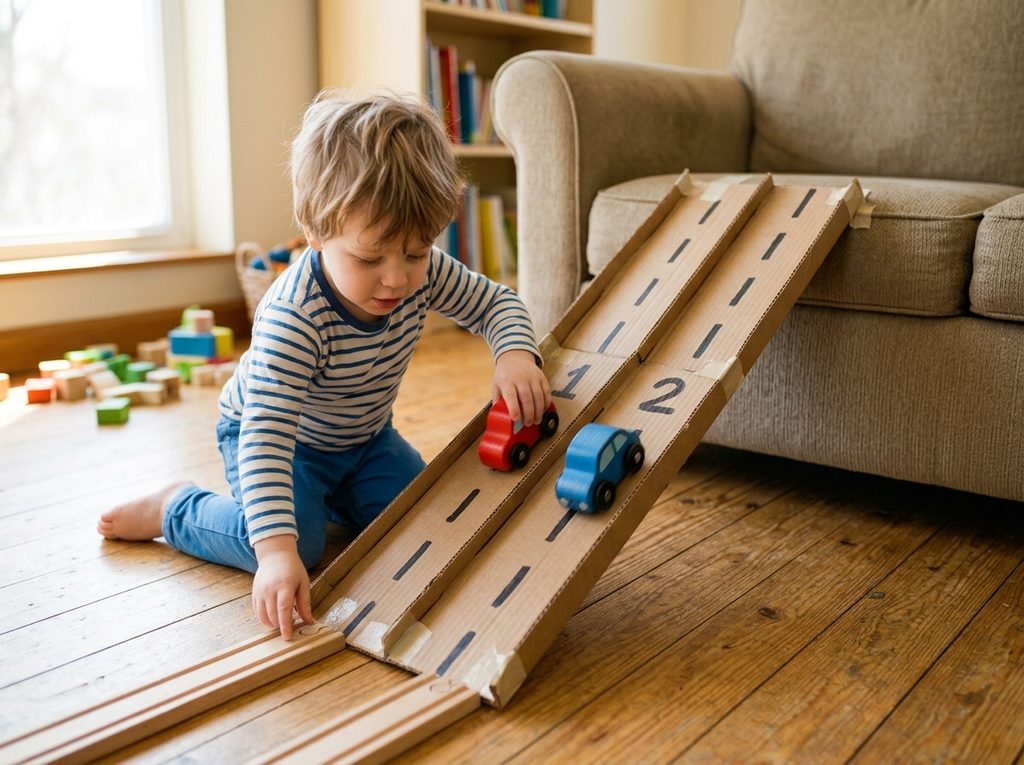
2. Cardboard Ramp Speed Test
Ages: 3–5 · Builds: physics, predicting, measuring
What You’ll Need: a long piece of cardboard, books for stacking, several toy cars, painter’s tape
- Lean the cardboard on a stack of two books to make a ramp.
- Race two cars side by side and see which goes farther.
- Mark where each car stops with a piece of tape.
- Add more books to make the ramp steeper, then race again.
Variation: Lay a towel at the bottom of the ramp and compare how far cars roll on fabric versus the floor.
Pro-Tip: Change only one thing at a time, like the height of the ramp. That’s how real scientists run a fair test.
3. Land, Air & Water Sorting Mat
Ages: 3–5 · Builds: sorting, logic, vocabulary
What You’ll Need: large paper or poster board, blue, green, and light blue crayons, toy vehicles or vehicle pictures
- Divide the paper into three sections: sky, road, and water.
- Color each section to match.
- Hand your child one vehicle at a time to place in the right area.
- Ask, “How do you know it goes there?”
Variation: Add a fourth “tricky” box for vehicles that fit two groups, like seaplanes and hovercraft.
Pro-Tip: No toy boats or planes? Use vehicle pictures from old magazines.
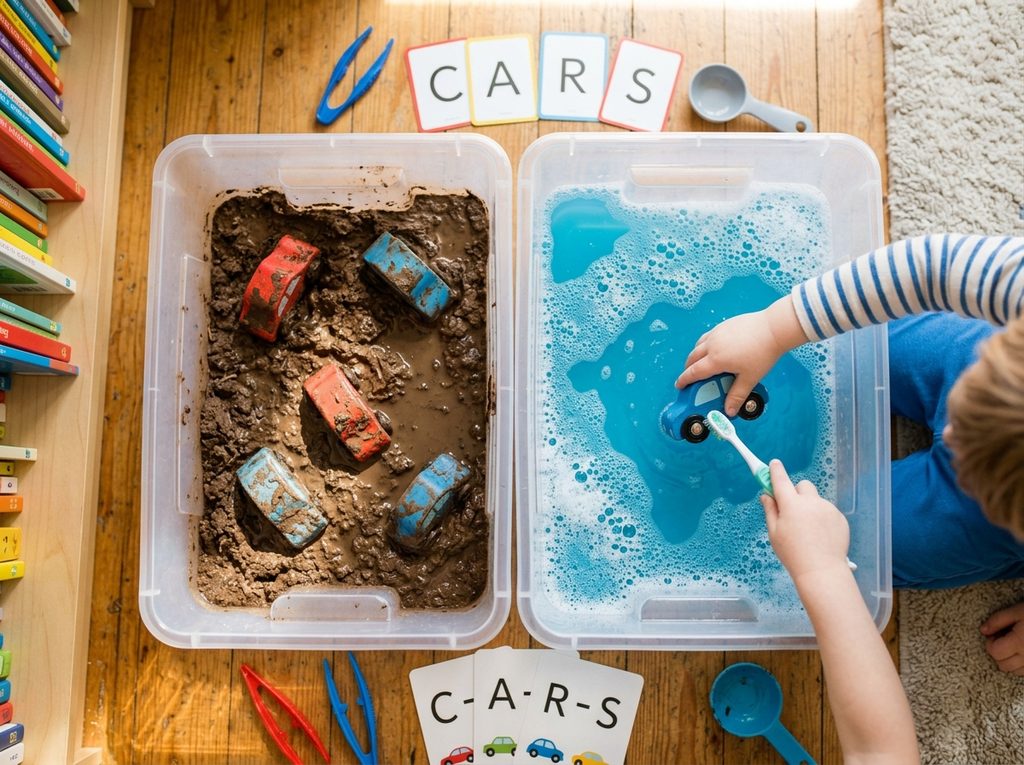
4. Muddy Car Wash Bin
Ages: 2–5 · Builds: sensory exploration, hand strength, responsibility
What You’ll Need: a bin of soapy water, a second bin with mud, plastic toy cars, sponges, old toothbrushes, a towel
- Drive the cars through the mud bin until they’re nice and dirty.
- Move them to the soapy water “car wash.”
- Scrub with sponges and toothbrushes.
- Dry each car on the towel and line them up in the “parking lot.”
Variation: For younger kids, make taste-safe “mud” from cocoa powder and water.
Pro-Tip: Use plastic cars, since metal ones can rust. Always stay close during water play.
5. Tire Track Stamp Painting
Ages: 2–5 · Builds: cause and effect, art, comparing
What You’ll Need: large paper, washable paint on paper plates, toy cars with different tire patterns
- Tape a big sheet of paper to the table.
- Roll each car through the paint.
- Drive it across the paper to make tracks.
- Compare the patterns and guess which car made which track.
Variation: Paint a road scene first, then add tire tracks on top.
Pro-Tip: Choose cars with chunky, bumpy wheels for the clearest tracks. Rinse them right after painting.
6. Alphabet Train Tracks
Ages: 3–5 · Builds: letter recognition, letter sounds, fine motor skills
What You’ll Need: painter’s tape, a marker, a toy train or car
- Tape a long train track across the floor.
- Write a letter on a piece of tape at each “station.”
- Call out a letter and have your child drive the train to that station.
- Say the letter’s sound together at each stop.
Variation: Spell your child’s name with the stations in order. For more letter practice, grab our free alphabet and tracing printables.
Pro-Tip: Start with just 4 or 5 letters, beginning with the ones in your child’s name.
7. Foil River Boat Race
Ages: 3–5 · Builds: engineering, breath control, predicting
What You’ll Need: aluminum foil, a long shallow container or baking tray of water, straws
- Help your child shape a small boat from a square of foil.
- Float the boat at one end of the water “river.”
- Blow through a straw to push the boat across.
- Race two boats and talk about which shape worked best.
Variation: Add a few large plastic counters to test which boat carries the most cargo before sinking.
Pro-Tip: Flat-bottomed boats with tall sides float best. Supervise all water play, even shallow trays.
8. Construction Excavation Bin
Ages: 3–5 · Builds: digging, counting, early engineering
What You’ll Need: a shallow bin, dry rice or crushed cereal, toy diggers and dump trucks, large blocks or toy rocks
- Fill the bin with rice or cereal.
- Bury large blocks or toy rocks throughout.
- Use diggers and spoons to excavate each treasure.
- Count the finds and load them into a dump truck.
Variation: Dress up and pretend to run the work site, just like the construction zone in our community helpers activities.
Pro-Tip: Use crushed cereal for kids who still mouth things, and set the bin on an old sheet for quick cleanup.
9. Traffic Light Stop-and-Go
Ages: 2–5 · Builds: listening, self-control, gross motor skills
What You’ll Need: red, yellow, and green paper circles
- Hold up the green circle and have kids “drive” around the room.
- Show yellow and have them slow down.
- Flip to red and everyone freezes.
- Take turns letting your child be the traffic light.
Variation: Add a stop sign and a crosswalk to practice pedestrian rules.
Pro-Tip: This game is great for practicing real street safety, like holding a grown-up’s hand when crossing.
10. Shape Vehicle Collage
Ages: 3–5 · Builds: shape recognition, cutting, creativity
What You’ll Need: paper shapes (rectangles, circles, triangles, squares), glue stick, large paper, child-safe scissors
- Cut out a pile of paper shapes, or let older kids cut their own.
- Show how a rectangle and two circles make a car.
- Let your child build trucks, trains, boats, or rockets.
- Name and count each shape as it goes on the page.
Pro-Tip: Cutting thick paper strips first is easier than cutting shapes. Snipping builds the hand strength kids need for writing.
Easy DIY Tracks & Supplies for Budget-Friendly Play
You don’t need an expensive track set for great vehicle play. Some of the best tracks come straight from the recycling bin.
Build With What You Have
- Cardboard boxes: Cut doors to make a garage, or open both ends for a tunnel.
- Paper towel tubes: Tape them to a wall at an angle for a car chute.
- Masking tape: Make roads, train tracks, and parking spots on any floor.
- Shoeboxes: Turn them into a car wash, a gas station, or a ferry boat.
Our Favorite Transportation Supplies
A small set of sturdy cars covers most activities in this post. We like Die-Cast Toy Car Set – A pack of small metal cars and trucks with rolling wheels that work great on ramps and tape roads.
For instant roads, try Peel-and-Stick Road Tape – Removable tape printed with road lines that sticks to floors and tables without leaving residue.
For the car wash and boat race, a dedicated water station keeps the splashing in one place. Try Kids’ Water Play Table – A standing-height table with water basins for outdoor scooping, pouring, and boat play.
Pro-Tip: Small toy cars are a choking hazard for kids under 3. Keep them away from babies and toddlers in the house.
Frequently Asked Questions (FAQ)
What age is best for introducing land, air, and water sorting?
Around age 3 is a great time to start. Many 3-year-olds can sort by one simple rule, especially with familiar vehicles like cars, boats, and airplanes.
Two-year-olds can begin with just two groups, like “goes on the road” and “goes in the water.” By 4 and 5, kids enjoy tricky vehicles and explaining their choices.
How can I keep vehicle play engaging without buying expensive track sets?
Keep it fresh by changing the setup, not the toys. Tape a new road, build a ramp from a different height, or move play outside to the sidewalk with chalk.
Rotate a few vehicles in and out each week so old favorites feel new again.
Low-Cost STEM Fun That Keeps Kids Rolling
Transportation activities don’t need fancy kits to teach big ideas. A strip of tape, a cardboard ramp, and a bin of water can spark hours of learning.
Pick one or two activities this week and let your preschooler take the wheel. Every race, sort, and splash builds a curious little scientist. Ready, set, go!
About the Author


1 thought on “10 Fun Vehicle & Transportation Activities for Preschoolers (STEM & Play)”